Balak the king of Moab was terrified of the Jewish nation on their way to conquer the Promised Land. Balak hires the heathen prophet Bilam to curse the Jewish people. Bilam accepts the challenge, but all his curses were transformed into exquisite blessings.
One of the most famous of Bilam’s blessings is the one recited every morning: “How goodly are your tents, O Jacob, your dwelling places, O Israel.” (Bamidbar 24:5)
There are two interpretations of this blessing.
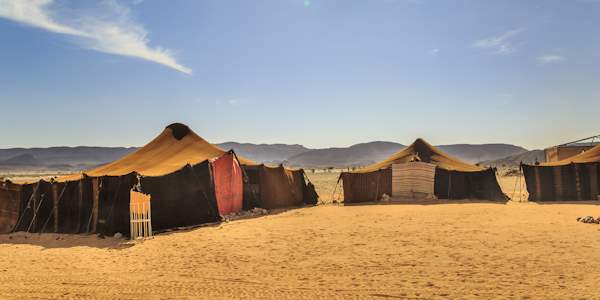
One interpretation is that Bilam saw the way the Israelites pitched their tents. They ensured that the entrances of their tents did not face the entrances of their neighbors. This emphasis on privacy and modesty so impressed Bilam that he was moved to utter this blessing.
Another interpretation is that Bilam was referring to the Houses of Worship and Houses of Torah Study.
Now, the Talmud (Sanhedrin 105) states that all of Bilam’s blessings eventually reverted to curses — with one notable exception: the blessing of Mah Tovu. This blessing remained in force throughout Jewish history.
The reason Bilam’s blessings reverted to curses is that, in his heart, he intended to curse. His blessings were not sincere.
If that is the case, we must understand why the blessing of Mah Tovu remained unchanged.
Sincere Blessing
According to the first interpretation — that he was referring to the tents and the modesty of the people — we may suggest that this blessing was indeed sincere. When Bilam witnessed the degree of modesty that the Israelites practiced, he was genuinely impressed, and this moved him to utter that blessing. The other blessings were actually G-d’s transformation of his intended curses into blessings. This one, however, was a reaction to his own inspiration.
However, according to the second explanation — that Mah Tovu refers to synagogues and Houses of Study — why did this blessing not revert to Bilam’s intended curse?
The Talmud (Berachos 8a) ) relates that Rabbi Yochanan, the leading sage in Israel in the first generation of the Talmud and the redactor of the Jerusalem Talmud, once expressed bewilderment upon being told that there were elderly people living in Babylonia. He remarked: “It is written in the Torah, ‘In order that your days shall be lengthened upon the land’” — implying that longevity is limited to life in the Land of Israel. When he was informed that the people in Babylonia arose early to go to synagogue and remained late in prayer and study, he responded,
“That is what endows them with longevity.”
This raises a question: If the Torah connects longevity with living in the Land of Israel, how can early and late attendance at the synagogue replace that?
The Maharsha answers this question by referring to the Talmud (Megillah 29a), which states: “In the future, synagogues and Houses of Study will be transplanted to the Land of Israel.” Hence, synagogues in the Diaspora are actually considered part of the Land of Israel. Perhaps it can be compared to an embassy situated in a foreign country, which is nevertheless regarded as sovereign property of the nation it represents.
The work Minchas Ze’ev posits that this concept is actually alluded to in the words of Mah Tovu: “How goodly are your tents, O Jacob” refers to the synagogues in the Diaspora, when the Jewish people are in the lower spiritual state associated with the name Jacob. Nevertheless, the Torah continues, these tents are equivalent to “your dwelling places, O Israel” — a higher state representing the sanctity of the Land of Israel.
With this introduction, we can now understand why this blessing did not revert to a curse.
No Curses From Israel
All blessings that are manifest in the Land of Israel cannot be turned into curses, because the Land of Israel is the place where G-d’s presence is revealed.
It is the land about which the Torah says: “It is a land that the L-rd your G-d watches over constantly, from the beginning of the year to the end of the year.” This means that there is no obstruction to His blessings.
When can a blessing revert to a curse? Only when G-d’s presence is obscured. In the presence of G-d, there are no curses.
There is a well-known story of Rabbi Dovber (the son and successor of the Alter Rebbe as the leader of Chabad) as a child heard the reading of the Tochecha-the curses recorded in Deuteronomy and fainted. When he was asked why he didn’t faint in previous years he answered that “in previous years his father read the Torah and when father reads the Torah there are no curses.” A loving father never truly curses; even His harsh words are veiled expressions of love.
However, when the Jewish people were exiled, they entered a period where G-d’s presence is hidden. It is a time of spiritual darkness. In such conditions, blessings can be transformed into curses.
Yet, when we construct Houses of Prayer and Houses of Torah Study in the Diaspora, they become embassies of light in exile and attain the same spiritual status as those in the Land of Israel. Therefore, Bilam’s intention for his words to be curses couldn’t override the power of a blessing uttered in reference to a place that reflects G-d’s presence.
The Rebbe often stated that when a Jew transforms his own home into a place of prayer and Torah study, it acquires the same status as a synagogue or House of Study.
It follows then that, to ensure that none of Bilam’s intended curses penetrate our homes — G-d forbid — we must make our homes virtual synagogues and Houses of Study. This will make us impervious to any of Bilam’s curses and pave the way for the promise that all such Houses will be transplanted to the Land of Israel with the imminent coming of Moshiach.
We can take the above idea one step further.
No Curses From G-d
The concept that curses do not originate from G-d is rooted in the verse in Deuteronomy: “Behold, I have set before you today a blessing and a curse.”
The Aramaic translation of this verse — known as Targum Yonatan — renders the word for “curse” differently than it does in all other instances. Instead of the usual me’latataye or levatin (as does Onkelos), he uses the word chilufah, which means exchange.
The Rebbe explains that when the Torah says, “I have given you” — i.e., from G-d — it cannot mean a true curse. Only blessings come directly from G-d. However, we, through our negative actions, have the power to exchange the energy of blessing into a curse.
Thus, in the Land of Israel, which receives its spiritual flow directly from G-d, there can be no curses — unless we actively and tragically exchange the blessings into curses. This dynamic explains the destruction of the Beis Hamikdash and the ensuing exile.
In contrast, the Diaspora does not benefit from the same direct flow. It is vulnerable to concealment and negativity. However, when we transform our surroundings into sacred space — by converting our homes and structures into Houses of Prayer and Torah — we become spiritually aligned with Israel and once again receive divine energy directly, making us impervious to curses.
The only factor that can impede this process is when we utilize our synagogues and Houses of Study for negative behaviors — particularly those that breed discord and strife. In such a case, we lose the vessel for blessing, which, according to our Sages (in the very last Mishnah), is peace.
As we say in our prayers: “Bless us, our Father, all of us as one.” When we create unity and positive energy in a synagogue, we are transported into Israel, spiritually speaking.
This concept forms the basis for the Midrashic statement that in the Messianic Age, the Land of Israel will spread to the entire world. The entire world will become receptive to G-d’s revealed light, and we will enjoy perpetual blessings.