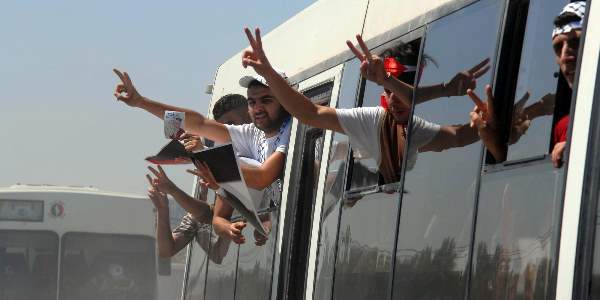
Apparently, Prime Minister Netanyahu continues to pursue a deal while under pressure from President Trump, who is eager to reach an agreement quickly. Meanwhile, Ministers Ben-Gvir and Smotrich oppose the deal, and Netanyahu is trying to convince them not to leave the government.
So, what is the Rebbe’s position on prisoner exchange deals?
First, it is important to recall:
1. The first such deal, brokered by Prime Minister Begin with the PLO in 1983, saw the release of 4,765 terrorists in exchange for just six soldiers. (Some of the terrorists were transferred to Algeria, but most were sent to Lebanon.)
2. In response to your letter regarding the second deal — which Prime Minister Shimon Peres made with the PFLP-GC leader Ahmed Jibril in 1985 — 1,150 terrorists were released in exchange for three soldiers.
These deals resulted in the release of thousands of trained, highly motivated Arab terrorists from prison, directly contributing to the outbreak of the First Intifada.
Yuval Diskin, who later became the head of the Shabak (Israel’s internal security service), commented: „The release of prisoners in the Jibril deal was the primary factor that led to the changes and processes which triggered the First Intifada. At the time, I was involved in field operations, and we could feel it on a daily basis. The mass release of terrorists created a new, radical, activist leadership. That, along with their boosted morale and the feeling that they had managed to bend Israel, led to an explosion.“
Former Defense Minister Moshe Arens later said: „As soon as I realized that some of the released terrorists were committing attacks again, it became clear to me that the deal was a mistake. But back then, we all went along without protest with the position of Defense Minister Yitzchak Rabin...“
3. One must also recall the Shalit deal, in which over 1,000 terrorists were released, including the arch-terrorist Yahya Sinwar — may his name be blotted out — the planner and orchestrator of the horrific Simchas Torah massacre.
Every one of these deals only strengthens terrorism, leads to further kidnappings, and, G-d forbid, to hundreds of additional terror attacks and murders.
4. Even earlier, in 1979, soldier Avraham Amram was released after spending nearly a year in captivity, in exchange for 76 terrorists.
The Lubavitcher Rebbe was outraged by this deal, declaring it a capitulation to terrorism — a dangerous break from Israel’s long-standing policy of not yielding to terrorist demands.
Indeed, this deal opened the floodgates to increasingly dangerous concessions. Once the „dam had been breached“, further, more reckless deals followed — including the aforementioned mass releases in 1983 and 1985.
The Rebbe, Melech HaMoshiach, expressed deep anguish over the release of Avraham Amram in exchange for about 70 terrorists. He emphasized that these terrorists were being released despite having committed acts of sabotage, and despite openly stating: „I ate — and I will eat again.“ In Toras Ohr, they say quite clearly that they will return to terror.
To our great sorrow, this is precisely what is happening today — thousands of terrorists are slated for release in exchange for hostages held in Gaza, even though they openly declare their hatred for Israel and their intent to continue terrorism. (Even if they’re asked to sign some document promising not to return to terror, everyone knows this is a meaningless formality, especially after years of public declarations made during their imprisonment.)
Take note: before the deal for the release of Avraham Amram — the very deal about which the Rebbe protested — there had been several prisoner swaps between states. But exchanges with terrorist organizations were extremely rare, and Israel adhered strictly to a policy of not releasing large numbers of terrorists for a single hostage.
For instance, in the 1970 deal with the terrorist group Fatah, only one Fatah prisoner was released in exchange for Shmuel Rosenwasser, who had been kidnapped in Metulla.
Alas, following the deal for Avraham Amram — which the Rebbe called a „breach in the dam“ — came two deals that resulted in the release of nearly 6,000 terrorists in exchange for nine hostages.
These very deals led to hundreds of acts of sabotage and murder, the outbreak of the First Intifada, and a surge in the motivation of terrorist groups to carry out more kidnappings — knowing that Israel would once again capitulate and release large numbers of terrorists.
The conclusion is clear: We must not surrender to terrorism. Any concession inevitably leads — may G-d protect us — to more bloodshed, more kidnappings, more attacks, and more innocent lives lost.
Here is a translation of excerpts from the talk of the Rebbe King Moshiach two and a half months after the release of terrorists in exchange for Avraham Amram.