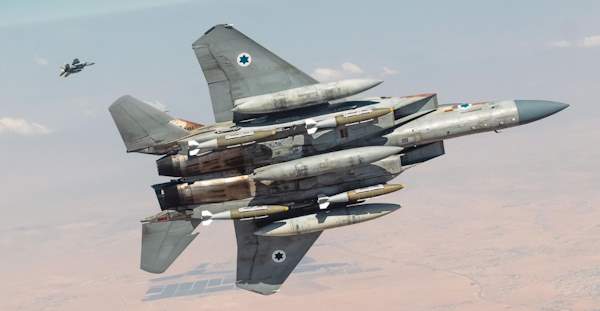
Last night, the Israeli Air Force launched a large-scale strike on five Iranian airbases. The operation resulted in the destruction of 15 combat aircraft, including fighter jets, helicopters, a refuelling aircraft, and unmanned aerial vehicles. Among the aircraft destroyed were F-14 fighters, considered the “first line” of the Iranian Air Force. These aircraft, contemporaries of the American F-15s and F-16s, have undergone decades of modernisation and overhaul within Iran. They are equipped with long-range radar systems. In addition, F-5 fighters were also hit—aircraft from the same era as the F-4 Phantom.
Among the destroyed equipment were “Cobra” attack helicopters. In recent days, the Israeli Air Force has eliminated eight such helicopters, with several more destroyed in the overnight strike. Estimates suggest that the Iranian Air Force retains around 50–70 helicopters of this type, out of approximately 200 originally purchased during the Shah’s reign, before the Islamic Revolution.
The goal of this systematic and targeted destruction of the Iranian Air Force is not only to weaken Tehran’s military capabilities, but also to create the conditions for:
The emergence of a civilian uprising within Iran;
The erosion of morale and command effectiveness within the Iranian military structures;
The expansion of Israel’s operational airspace, enabling the free use of drones and combat aircraft over Iranian territory.
This morning, the head of Israel’s National Security Council reported another significant outcome: approximately 800 Iranian missiles were “buried” in tunnels as a result of the bombings. According to him, launch shafts were destroyed and the tunnels partially collapsed, rendering launches impossible.
In addition, Iran has already expended around 500 missiles from its total stockpile of 2,500. Thus, approximately 1,200 missiles remain in service. However, not all of them are capable of reaching Israeli territory. Hundreds of launchers have been destroyed, many operators eliminated, and the launches themselves have been pushed further eastward—reducing the range and effectiveness of missile attacks.
The decline in the intensity of bombardments is linked not only to Iranian losses but also to the increasing precision and effectiveness of Israeli air operations. With G-d’s help, and of course thanks to intelligence and technical means, Israeli forces were able to detect and neutralise new launch attempts in advance.
Will Iran Shift to a War of Attrition?
In light of these setbacks, Iran will likely attempt to shift to a strategy of prolonged conflict—a war of attrition. This approach involves occasional isolated missile launches aimed at wearing down the Israeli civilian population. A similar tactic was previously attempted by the Yemeni Houthis before their leadership was eliminated.
However, Israel is also prepared for this scenario. Should Iran begin to exhaust Israel’s home front, the IDF is capable of carrying out strikes that could bring devastating economic consequences for the regime. Potential targets include the oil and gas industry, tankers and the merchant fleet, power plants, telecommunications hubs, and water supply systems. The large-scale destruction of critical infrastructure could trigger the complete collapse of Iran’s economy.
Furthermore, if Iran transitions to a prolonged strategy, Israel will be able to escalate its direct pressure on the regime itself. This could include bombing police stations, Basij militia bases—an essential arm of the regime’s apparatus for suppressing dissent—as well as the destruction of symbols of state power such as the Iranian parliament building. The objective would be to encourage mass protests and help foment the internal overthrow of the regime.
Good tidings.