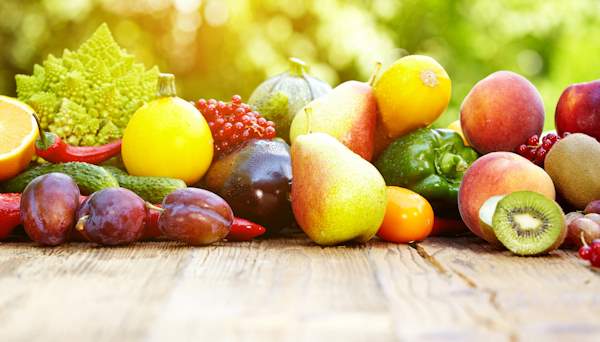
The Land: The lessons we can derive from Tes-Vav B’Shevat are associated with the word eretz meaning „earth“ or „land.“ In a spiritual sense, eretz is associated with the service of „wanting and running (ratza) to the will of the Creator,“ i.e., that a person should eagerly devote himself to the fulfillment of G‑d’s will.
This relates to every Jew, for on the verse, „you shall be a cherished land unto Me,“ the Baal Shem Tov explained that every Jew is a cherished land. Just like in the depths of the earth, there are gems and jewels, so too, every Jew has gems within him.
Nevertheless, just as in the world at large, gems are not usually strewn over the face of the earth, but must be dug out from the depths, so too, within each Jew, effort must be expended — „I labored and I found“ — for these jewels to be uncovered. Similarly, in producing the spiritual fruits of our souls, plowing, sowing, and other activities are necessary.
This is alluded to in the verse, „the earth which produces bread.“ Needless to say, the earth does not produce bread or any of the other types of produce alone, and requires man to perform various activities, plowing, sowing, and the like, for the earth to yield these products.
There is a parallel to each of the seven species for which Eretz Yisrael is praised in our spiritual service. To explain (in the order that the species are mentioned in the Torah, Devarim 8:8):
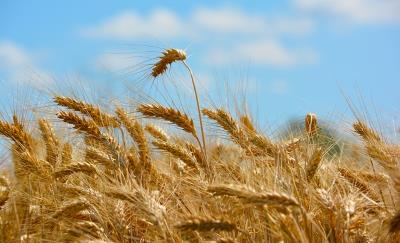
Wheat is described by our Sages as „food for humans.“ Thus it refers to service involving the aspect of our beings which is human, the G‑dly soul. The use of the term „food“ implies that this service, like actual food, must be assimilated into our being.
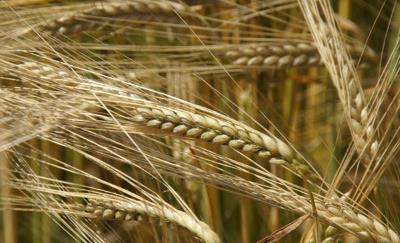
Barley — our Sages refer to barley as „food for animals,“ i.e., the elevation of the animal soul. Since this service is more difficult than the first, it follows it.
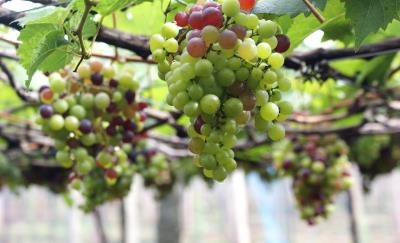
Grapes [remind us of the importance of serving Hashem with simcha, since they] are used to produce wine which „makes glad G‑d and men.“

Figs — the Torah relates that figs were used to make the first garments worn by man. Afterwards, G‑d gave man „leather garments.“ In regard to these leather garments, we find Rabbi Meir referring to them as „garments of light,“ rather than „garments of leather.“
This implies that a Jew’s service must involve spreading G‑dly light throughout the world.
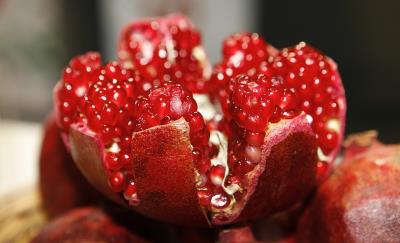
Pomegranates — in this context, we find the expression „filled with mitzvos as a pomegranate is filled with seeds.“ On one hand, each of the seeds of the pomegranate is a separate entity, on the other hand, the separation is an integral part of the fruit itself. This alludes to the concept that each mitzva has its own unique importance, but that this unique importance is endowed to the mitzva by the Torah, and not by outside entities.
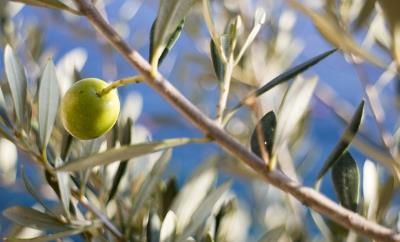
Olives are bitter. This implies that although a Jew’s life must be characterized by sweetness and goodness, he must, in times of introspection, come to a state of bitterness when evaluating his spiritual achievements.
Bitterness (merirus) is also associated with Miriam. The Torah describes her as standing on the side waiting to see what will happen to Moshe. There is a quality of Moshe in every Jewish soul. Miriam stands by that quality and helps it to develop. Furthermore, Miriam has an influence on Pharaoh, as reflected in the Torah’s narrative. It was she who caused Pharaoh’s daughter to care properly for Moshe.
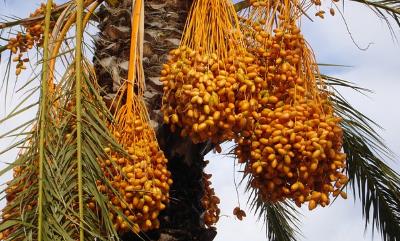
Dates are referred to in the verse cited above as „honey,“ which refers to Pnimiyus HaTorah, the Torah’s mystic dimensions. The study of these matters strengthens the inner dimensions of the Jewish soul, the aspect of our being which, in truth, controls our lives.
Dates are also associated with Devorah the Prophetess who is mentioned in the Haftorah of the previous Shabbos. For she is described as judging the people „under the date palm of Devorah.“ She shares a connection with the ultimate Redemption for through her efforts, „the land was at rest for forty years,“ and forty is associated with the Redemption.
Through developing a spiritual service that relates to all of these qualities and by spreading these concepts with others so they can do the same, we will merit to proceed to Eretz Yisrael, to Yerushalayim, and to the Beis HaMikdash. May this take place in the immediate future.